
Written heritage
The written heritage of the Casbah of Algiers
Most of this quarter's written record is not in a library. It is cut into marble and fired into tile, and it is attached to buildings that are falling down.
Ask where a city keeps its writing and the answer is usually an archive. In the Casbah the answer is largely the buildings themselves. Dates, donors, dedications and prayers were set into pulpits, mihrabs, fountain walls and doorframes, and that epigraphic record is doing real historical work: some of the firmest dates on this site come from it.
The inscription that dates the oldest building in the city
Djamaa el Kebir, the Great Mosque, was built in the year 490 of the Hijra, 1097 in the common era, under Yusuf ibn Tashfin. That date is not an estimate from the masonry or a guess from the style. It comes from an inscription on the minbar, the pulpit.
That is the clearest possible demonstration of why this material matters. A carved text on a piece of mosque furniture is the reason the oldest building in Algiers has a firm date at all.
The mosques page follows what else that building tells us.
The fountains, which are signed
The public fountains of Algiers were paid for by benefactors, and each carried a plaque, in marble or in shale, in Arabic or in Ottoman Turkish, setting out the merits of whoever had paid for it. That is an entire genre of civic writing, distributed across the street walls of the city, and it is also a register of who had money and wanted it known.
One survives with its text recorded. The fountain known as the Calle aux Vins was built by Dey Husayn in 1820. Its inscription opens with the line Everything lives through water, sets out the ruler's intention to bring running water in sufficient quantity to every place, and ends by telling the reader to drink.
Read that as a document rather than as decoration and it tells you three things at once: who was responsible for the water, how a ruler wished to be remembered, and that the supply was understood as an act of charity rather than a utility. The water page takes the administration behind it further.
Calligraphy as a living practice
Arabic calligraphy was inscribed on UNESCO's Representative List of the Intangible Cultural Heritage of Humanity in 2021, in a joint nomination in which Algeria took part. It is one of only twelve Algerian inscriptions, and it is among the few that connect directly to what the Casbah holds.
The connection is concrete. Dar Mustapha Pacha, built between 1798 and 1800 and one of the rare palaces to come through the French occupation without major alteration, has housed the national museum of illumination, miniature and calligraphy since 2007. The building itself is 709 square metres around a courtyard 9.5 metres square.
What is at risk, and it is not metaphorical
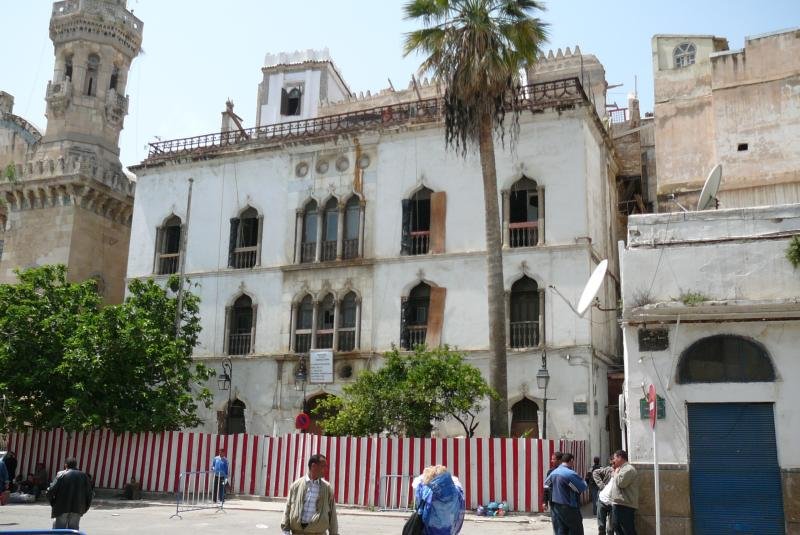
Epigraphy fixed to a building shares that building's fate. When a house comes down, its doorframes, its tilework and any text on them come down with it, and the record is not duplicated anywhere.
The scale of that exposure is on the citadel page in full: a recent count put 1,816 buildings still standing, about forty per cent of them critically damaged or already ruined and 373 collapsed outright. Every one of those collapses is potentially a lost inscription, and unlike a manuscript there is no second copy in another library.
The fountains have been treated slightly better. Five public fountains were reconstructed as part of the rehabilitation of two main Casbah streets.
What this page does not yet cover
The manuscript collections are missing from this page. Algeria holds significant collections of Arabic manuscripts, and the relationship between those holdings and the teaching institutions of the Casbah is a real subject that is not covered here, because no institutional catalogue or scholarly description of it was obtained when this page was written.
Also missing: the archives of the Regency of Algiers, the court and notarial records that would document the habus endowments building by building, and any systematic inventory of surviving inscriptions in the quarter. If such an inventory exists, it is the single most useful thing anyone could point this site at. Please write to admin@casbah-alger.com.
At a glance
The written record, in numbers
Every figure below is drawn from the sources listed at the foot of this page.
- 1097Djamaa el Kebir is dated to AH 490 by an inscription on its minbar.
- Marble or shaleThe materials of the fountain plaques, inscribed in Arabic or Ottoman Turkish, naming the benefactor.
- 1820The Calle aux Vins fountain is built by Dey Husayn. Its inscription survives and begins: Everything lives through water.
- 2021Arabic calligraphy is inscribed by UNESCO, in a joint nomination in which Algeria took part.
- 2007Dar Mustapha Pacha becomes the national museum of illumination, miniature and calligraphy.
- 709 m²The floor area of that building, around a courtyard 9.5 metres square.
- 1,816Buildings standing in the Casbah in a recent count. About 40 per cent are critically damaged or ruined, and 373 have collapsed.
- 5Public fountains reconstructed during the rehabilitation of two main Casbah streets.
Keep reading
Where this leads


Sources
Where this comes from
- Discover Islamic Art, Museum With No Frontiers, Djama‘a al-Kebir, the Great Mosque of Algiers
- Discover Islamic Art, Museum With No Frontiers, the public fountains of Algiers
- UNESCO, Intangible Cultural Heritage, elements inscribed for Algeria
- Archnet, Dar Mustapha Pacha, Aga Khan Documentation Centre, MIT
- Apollo Magazine, The Algerians battling to save the Casbah from crumbling
- Boussaa, The Casbah of Algiers, in Algeria: from an urban slum to a sustainable living heritage, American Transactions on Engineering and Applied Sciences 1(3), 2012
- UNESCO World Heritage Centre, Kasbah of Algiers
Casbah of Algiers
An independent record of the medina of Algiers, its architecture, its history and its people. Written and maintained by Samir Sibachir.
© 2026 casbah-alger.comEvery figure on this page is traceable to the sources listed above.