
Mosques
Mosques of the Casbah of Algiers
The city once had about a hundred and thirty of them. It has ten. These are the three that matter most, and the arithmetic of what happened to the rest.
Three buildings carry the religious history of Algiers, and each of them carries it differently. One is nine hundred years old and has never stopped being a mosque. One was built to settle an argument about which school of law the city followed. One spent a hundred and thirty years as a cathedral. Between them they explain more about the city than any amount of general description.
Djamaa el Kebir, 1097
The Great Mosque is the oldest building in Algiers still doing the job it was built for. It was raised in the year 490 of the Hijra, 1097 in the common era, under Yusuf ibn Tashfin, in the Almoravid period. The date is not a guess. It comes from an inscription on the minbar, the pulpit.
The plan is wider than it is deep. Eleven naves run perpendicular to the qibla wall, divided by pillars carrying semi-circular arches of lime-washed masonry, each nave under its own double-sloping roof, with transverse poly-lobed arches tying the whole structure across. The rectangular courtyard is bordered on its two narrower sides by a riwaq, a gallery.
Two things in the building are not original, and both are informative. The mihrab is a reconstruction, because the original was destroyed in a bombardment in 1682. What stands now is flanked by two small spiral columns and topped with a pointed arch worked in relief stucco. And the minaret is a later addition, put up in 732 of the Hijra, 1332, at the northwest corner. The oldest mosque in the city spent its first two hundred and thirty five years without a tower.
The portico of columns and poly-lobed arches along the front is later still. It was built at the beginning of the colonial period because the street outside had been realigned, and the mosque needed a new face to meet it.

One of the surviving mosques of the lower city. Ten are left of roughly a hundred and thirty.
Djamaa el Djedid, 1660, and the cross that is not a cross
The New Mosque was built in 1070 of the Hijra, 1660, for Dey Mustafa Pasha, on the site of the Abu Inan madrasa. The quarter around it also held a smaller mosque used by the fishermen, and the Gate of the Sea. It follows Hanafite practice, which matters: Algiers under the Ottomans had a Hanafi ruling class and a largely Maliki population, and the two schools got their own principal mosques.
Structurally it is the most ambitious building in the Casbah. An ovoid central dome, whose inner surface reaches twenty four metres at the summit, rests on four pillars by way of a drum and four pendentives. Four octagonal cupolas sit in the corner spaces, separated from the centre by barrel vaults. The vault opposite the qibla wall runs over three bays and is flanked by two aisles.
Draw that plan and it comes out as a Latin cross. This is the single most repeated story about any building in Algiers: that a Christian architect, a captive, signed the mosque with the symbol of his own faith and was executed for it. It is a myth. The cross shape is what you get when you put a central dome on four piers and extend one arm of the vaulting, and the story grew up around the geometry afterwards. It is worth knowing precisely because you will be told it, and because the truth about the building is more interesting than the legend: someone in 1660 Algiers was confident enough to attempt a twenty four metre dome.

Ornament in a Casbah interior follows one rule, religious or domestic: it sits low, where a person meets the building.
Ketchaoua, the building that changed religion twice
Ketchaoua was built in 1612, and enlarged under Pasha Hassan. The record gives both 1792 and 1794 for that enlargement, and this page is not going to pretend to know which. The enlargement is what turned it into the principal mosque of the lower Casbah.
The name is local and unofficial. It is attributed to the Turkish word for goat, after a livestock market that used to be held nearby. The site is older than the mosque: Roman structures underneath it have been confirmed, and historians hold that the mosque replaced an eleventh-century church. Four layers of use, then, on one plot.
In 1832, two years after the fall of the city, the French took it for Christian worship, and in 1845 it was consecrated as the cathedral of Saint Philippe. It served as a church for about a hundred and thirty years. At independence in 1962 the first Friday prayer in over a century was held in it again.
Its most recent chapter is a restoration funded by the Turkish state under a protocol signed in September 2013. The building reopened on 9 April 2018 after four years of work. It is the clearest success in the whole conservation story of the Casbah, and it happened because a foreign government paid for it.
What happened to the other hundred and twenty
The numbers are stark and they are worth stating in full. A quarter that once held a hundred and thirty mosques and eighteen zaouias now has ten mosques and two zaouias. Of about a hundred hammams, six survive.
Some of that is the demolition of the lower city after 1830, which took whole streets at a time. Some of it is the general collapse of the fabric: the same survey that counted the mosques recorded around twelve hundred traditional buildings in 1962 and about four hundred surviving dwellings by 1992.
But there is a specifically religious mechanism in it too. These buildings were not funded by congregations. They were funded by habus, endowments of property whose income was permanently assigned to the upkeep of a mosque, a fountain or a school. An endowed building has a maintenance income for as long as the endowment holds. Break the link between the endowment and the building and you have a structure with a repair bill and nothing to pay it with. That is the quiet reason a mosque can stand for eight hundred years and then fail in eighty.
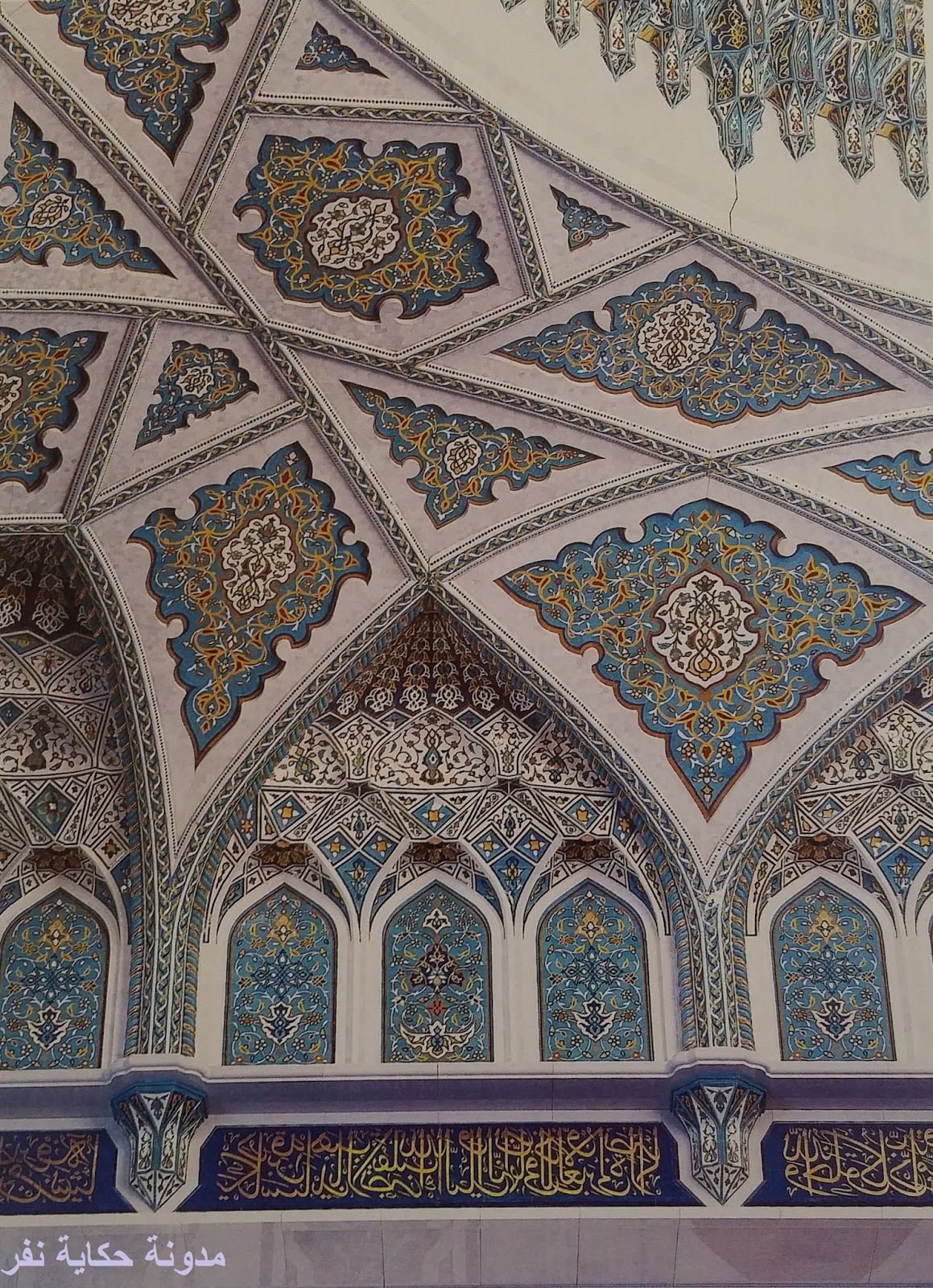
A worked ceiling. In a building with no endowment left, this is the first thing to go and the last thing anyone can afford to put back.
What this page does not yet cover
There are mosques and mausoleums in the Casbah that deserve proper treatment and are not here yet, because I have not found sources for them that meet the standard the rest of this site is held to. Sidi Abderrahmane, the mausoleum of the patron saint of Algiers, is the main omission. The Safir mosque, the smaller neighbourhood mosques, and the madrasas are others.
They will be added when there is something reliable to say, and not before. In the meantime, if you have documentation on any of them, or you can correct anything above, please write to admin@casbah-alger.com.
Four words
The vocabulary of the mosque
Minbar
The pulpit. The one in the Great Mosque carries the inscription that dates the whole building to 1097.
Mihrab
The niche in the qibla wall showing the direction of prayer. The Great Mosque's was destroyed by bombardment in 1682 and rebuilt.
Riwaq
A gallery along the side of a courtyard. The Great Mosque has one on each of the courtyard's two narrower sides.
Habus
A permanent endowment of property whose income maintained a mosque, a fountain or a school. Cut the endowment and the building loses its repair money.
At a glance
Dates and figures
Every figure below is drawn from the sources listed at the foot of this page. Where the record gives two dates, both are shown.
- 1097Djamaa el Kebir is built under Yusuf ibn Tashfin, in the Almoravid period. The date comes from an inscription on the minbar.
- 1332A minaret is added at the northwest corner of the Great Mosque, two hundred and thirty five years after the mosque itself.
- 1612Ketchaoua is built, on a site that already held Roman structures and, historians hold, an eleventh-century church.
- 1660Djamaa el Djedid is built for Dey Mustafa Pasha, on the site of the Abu Inan madrasa.
- 1682A bombardment destroys the original mihrab of the Great Mosque.
- 1790sKetchaoua is enlarged under Pasha Hassan into the principal mosque of the lower Casbah. The record gives both 1792 and 1794.
- 1832Two years after the fall of the city, the French take Ketchaoua for Christian worship.
- 1845Ketchaoua is consecrated as the cathedral of Saint Philippe. It serves as a church for about 130 years.
- 1962Independence. The first Friday prayer in over a century is held in Ketchaoua again.
- 2013A protocol is signed in September for the Turkish-funded restoration of Ketchaoua.
- 2018Ketchaoua reopens on 9 April, after four years of work.
- 24 mThe height reached by the inner surface of the dome of Djamaa el Djedid.
- 11The naves of the Great Mosque, divided by pillars carrying semi-circular arches.
- 130Mosques once recorded in the Casbah. Ten remain.
- 18Zaouias once recorded. Two remain.
- 100Hammams once recorded. Six remain.
Keep reading
Where this leads


Sources
Where this comes from
- Discover Islamic Art, Museum With No Frontiers, Djama‘a al-Kebir (Great Mosque)
- Discover Islamic Art, Museum With No Frontiers, Djama‘a al-Djedid (New Mosque)
- Archnet, Djamaa Ketchaoua, Aga Khan Documentation Centre, MIT
- Archnet, Jami‘ al-Kabir (Algiers), Aga Khan Documentation Centre, MIT
- TİKA, restoration and reopening of the Ketchaoua Mosque
- Discover Islamic Art, Museum With No Frontiers, the public fountains of Algiers
- Boussaa, The Casbah of Algiers, in Algeria: from an urban slum to a sustainable living heritage, American Transactions on Engineering and Applied Sciences 1(3), 2012
- UNESCO World Heritage Centre, Kasbah of Algiers
Casbah of Algiers
An independent record of the medina of Algiers, its architecture, its history and its people. Written and maintained by Samir Sibachir.
© 2026 casbah-alger.comEvery figure on this page is traceable to the sources listed above.