
Rais Hamidou
Rais Hamidou
The most famous captain the Regency of Algiers produced, and the five hours off the Spanish coast that ended both his life and the city's oldest source of income.
Algiers lived from the sea for three centuries. Its ship captains, the raïs, were the men who made that living, and of all of them one name has stayed in the city's memory: Hamidou. He died on 17 June 1815 in an action against an American squadron, and the treaty signed thirteen days later closed the era he belonged to.
What is actually documented
Less than you would hope. The dates usually given for him are 1773 to 1815, and he is identified as the Algerian naval commander who led raids on American merchant shipping in the Mediterranean and demanded ransom for the crews. He commanded the Mashouda, the flagship of the Algerian fleet.
This page is deliberately short, because the sources that meet the standard the rest of this site is held to are thin. His birth in the Casbah, his family, his trade before the sea and the individual captures attributed to him are all widely repeated and none of them could be verified here against an institutional or peer-reviewed source. They are left out rather than dressed up.
What is documented in detail is how he died, because the other side of that engagement kept careful records.
17 June 1815, off Cape Gata
A squadron was assembled at New York under Captain Stephen Decatur and sailed on 20 May 1815, with the frigate Guerriere as its flagship. Four weeks later, off the south-east coast of Spain, it met the Algerian fleet.
The United States Navy's own account is brief and clinical. The frigate Constellation drove the forty-four-gun Meshuda under the guns of Decatur's flagship. With two broadsides, the American frigate drove below all who were not killed or disabled on the Algerian ship's decks. The flagship surrendered. Among her fatalities, the record says, was the ranking naval officer of Algiers. It does not name him.
The Algerian account of the same action survives as a painting, of which a version was sold at auction in 2022 and a comparable one is held by the Metropolitan Museum in New York. It shows the Mashouda identified by her red stern flag, surrounded by nine American vessels in cannon smoke. Its Arabic inscription records that about eighty souls died, in an engagement it describes as lasting five hours.
Two broadsides or five hours. Both accounts are contemporary, and this page does not pretend to know which is closer. The gap between them is itself worth noticing: one side was recording a manoeuvre, the other was recording a loss.
And then the treaty
On 30 June 1815 a treaty was negotiated aboard the Guerriere at Algiers. It ended the payment of tribute by the United States and exacted full payment for injuries to American commerce.
That is the sentence that matters for this city rather than for that navy. Tribute and ransom were not a sideline of the Regency of Algiers, they were a substantial part of how it paid for itself, and the fountains, the mosques and the palaces on the rest of this site were built out of that economy. Fifteen years after the treaty the French fleet arrived, and the rest of the story follows from there.
The raïs as a class
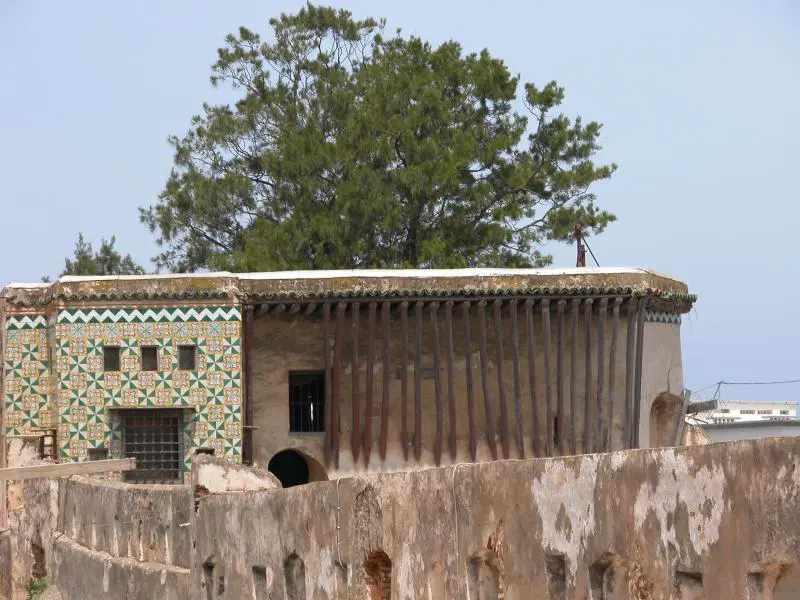
Hamidou was not an isolated adventurer. The ship captains were an established part of the city, and they had their own quarter at the waterline. The complex now known as Bastion 23, the Palace of the Raïs, is four palaces and several houses covering more than half a hectare on the seafront, and it was lived in by the raïs and by the men who worked the port. It survived the demolition of the marine quarter after 1830, which almost nothing else did, and it is covered on the dars and palaces page.
So when you stand in those rooms you are standing in the housing of the trade Hamidou belonged to. That is a more useful thing to know about him than any of the stories this page has left out.
Corrections welcome, and needed
This is the page on this site most likely to be improved by somebody who knows more than I do. If you have documentation on Hamidou's life before 1815, in Arabic, French or English, from an archive, a museum or published scholarship, please write to admin@casbah-alger.com. It will be read, and if it holds up it will go on the page with a credit.
At a glance
What the record says
This page carries fewer claims than most accounts of Rais Hamidou, because most accounts rest on sources that could not be checked.
- 1773The birth year given for Rais Hamidou in the catalogue record of a contemporary painting of his last action.
- 20 May 1815A squadron under Captain Stephen Decatur sails from New York, with the frigate Guerriere as flagship.
- 17 Jun 1815Off Cape Gata, the Constellation drives the 44-gun Mashouda under the Guerriere's guns. The Algerian flagship surrenders.
- 44Guns carried by the Mashouda, flagship of the Algerian fleet.
- Two broadsidesThe United States Navy's description of the engagement. A contemporary Algerian painting describes five hours.
- c. 80Deaths recorded in the Arabic inscription on that painting.
- UnnamedThe US Navy record notes that the ranking naval officer of Algiers was among the dead, without naming him. The auction catalogue identifies him as Hamidou.
- 30 Jun 1815A treaty is negotiated aboard the Guerriere at Algiers, ending the payment of American tribute.
Keep reading
Where this leads


Sources
Where this comes from
- Naval History and Heritage Command, US Navy, Dictionary of American Naval Fighting Ships: Guerriere I
- Sotheby's, catalogue entry for The Rais Hamidou of Algiers fights alone against the American fleet, Algeria, 19th century
- Discover Islamic Art, Museum With No Frontiers, Palace of the Raïs
- UNESCO World Heritage Centre, Kasbah of Algiers
Casbah of Algiers
An independent record of the medina of Algiers, its architecture, its history and its people. Written and maintained by Samir Sibachir.
© 2026 casbah-alger.comEvery figure on this page is traceable to the sources listed above.