
Water
Water in the Casbah of Algiers
A city with no river, on a hill, expecting to be besieged. Everything about how Algiers is built follows from that.
Algiers has no permanent watercourse. Not a river, not a stream. Everything the city drank had to be carried to it from the hills behind, pulled up out of the ground beneath it, or caught off its own roofs. Three separate systems, built over three centuries, and the Casbah is what a city looks like when it takes all three seriously.
Groundwater, springs, and rain
The resources were thin and they were counted. Nine springs are recorded around and in the city, with yields that differ enormously: Sidi Abderrahmane produced about 25 cubic metres a day, the spring in the ditches of the Bab Azzoun wall about 80, and the Bab Azzoun washhouse spring about 180.
Wells at Algiers were first recorded by the geographer al-Idrisi. By the thirteenth century the natural supply was no longer meeting the population, and the city dug harder. What it could not dig for, it caught: rainwater off the terraces, channelled down into a cistern under the courtyard.
The aqueducts, and why they are not Roman
This is the part that usually gets described wrongly. The aqueducts of Algiers are Ottoman, not Roman, and unlike Aleppo or Tunis the city did not inherit its water infrastructure from an earlier empire. It owes it to its Turkish rulers.
Between the middle of the sixteenth century and the first half of the seventeenth, four main aqueducts were built to supply the medina. Three more served the fahs, the countryside outside the walls. Those four supplied the slaughterhouses, the tanneries, the forts and batteries near the gates, and the public fountains, and they kept the city going until roughly 1910.
What makes them unusual is the engineering. They are not simple gravity channels. They use souterazi, inverted-siphon pressure towers, a technique brought from Constantinople. The word is a Persian and Turkish compound of sou, water, and terazi, balance: a water balance. The towers look something like an obelisk, and the one on the Aïn Zeboudja aqueduct stood eight metres high, according to the first French Engineers' survey of 10 May 1847. The conduits inside them were ceramic, not lead.
A souterazi halves the masonry an arcaded aqueduct would need, and it works on broken ground where a plain siphon will not. That is why a city on a steep, folded coastal hillside used them.
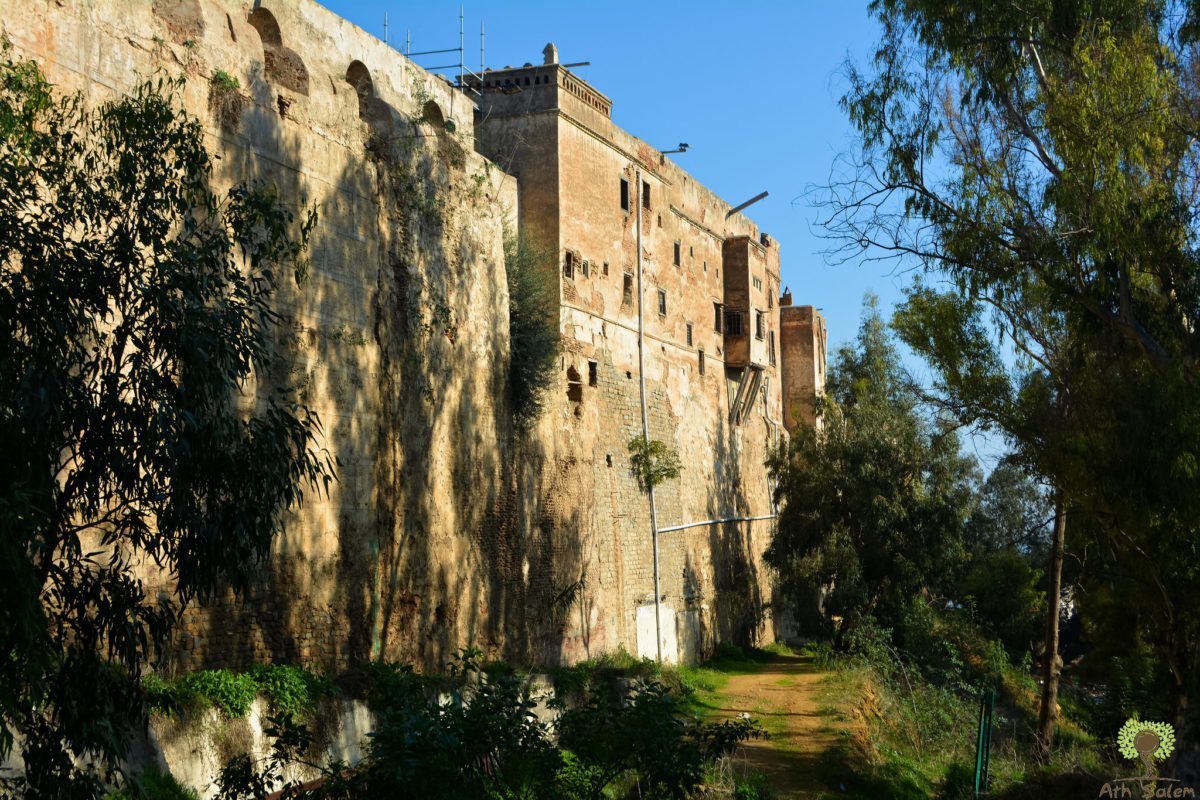
How many were there? In 1833 Captain Rozet, the geologist and geographer attached to the French army, put the aqueducts of the city and its countryside at more than two hundred. The last of the Ottoman ones is generally taken to be Aïn Zeboudja, built around 1619 by Charif Khodja Pacha, drawing on a spring near Dely Brahim and carrying its water to the Casbah. A surviving section of it, eighty metres long and twelve metres high, stands inside a private residence. It was classified as national heritage in 2012 and restored in 2014.

The courtyard is where the water arrived, and where it was stored. The cistern is underneath it.
The fountains, and a disagreement about how many
Water reached the street through public fountains, and the number of them is the usual measure of how the city was doing. It is also a number nobody agrees on, so here is the whole record rather than the convenient figure.
Discover Islamic Art gives seven fountains in the sixteenth century according to Haëdo, one hundred and twenty five according to the chevalier d'Arvieux in 1674 to 1675, and seventy three recorded in 1840. A survey of the travel and archival record by Dalila Kameche-Ouzidane gives a range of roughly one hundred to one hundred and fifty, itemised: more than a hundred from Pierre Dan in 1634, a hundred and twenty five from d'Arvieux, a hundred and fifty from Thomas Shaw in 1738, and seventy three from the report of the Engineers captain Guyot-Duclos dated 24 February 1840. The two sources agree on 1674 and on 1840 and not on much else. Part of the gap is definitional: the larger counts include the ablution fountains of the mosques and the fountains of the barracks and palaces, not only street fountains.
Most were built in the eighteenth century by the deys. They were paid for by benefactors, and each one carried a plaque, marble or shale, in Arabic or Ottoman Turkish, setting out the merits of whoever had paid. Behind them sat an administration: a khudjat al-‘uyun, a secretary of the fountains, running the habus endowments collected on the fountains' behalf.
One survives with its inscription readable. The fountain known as the Calle aux Vins was built by Dey Husayn in 1820 outside Bab al-Djazira, moved in 1867, endowed to the state in 1905, and moved again to stand against the wall of the Department of Antiquities. Its text begins: Everything lives through water. It ends by telling the reader to drink.
The well in the courtyard
Every house had its own well. That is not a figure of speech, it is close to literal, and it was reinforced by an obligation: owners were required to collect rainwater from their terraces and channel it down to the cistern beneath the patio. The reason is given plainly in the sources. It was so that the city could not be cut off from aqueduct water by siege or by earthquake.
The cistern is el-jebb: an underground reservoir of stone or brick, vaulted, set under the courtyard, lined with a waterproof plaster of lime and crushed tile, fed by gravity from the roof through built-in pipes. Sizes track the wealth of the house exactly. Many houses in the upper city have cisterns of twenty to twenty five cubic metres. Dar Khdaouedj el-Amia has one of nearly a hundred and fifty. The cistern of the dey's palace measures ten metres by 7.3 by 4.6, which is about three hundred and thirty six cubic metres, fed by rainwater off the palace roofs through ceramic pipes.
The well itself sat at the centre of the courtyard with a circular or square coping. Where it went was not a free choice: the placement of both wells and cisterns was governed by rules meant to stop disputes with neighbours over party walls, adjoining wells and foundations. Some wells had underground galleries running between them.
Depths in the sources differ, and they differ because they are measuring different parts of the city. One account describes wells cut into gneiss and schist, some fifty metres deep and reaching seventy between the citadel and the foot of the hill, the water column rising thirty metres in winter and dropping so far in summer that drawing became difficult. Another, reporting recent excavation, gives six to twelve metres. Both are probably right about what they looked at.
The water was not always good. Haëdo records that although every house had a well, the water was often salty and bitter and not fit to drink.
Who actually fetched it
The domestic wells were mainly used and maintained by women, who were responsible for the household's water for cooking, washing and cleaning. Given that the house turns inward and the courtyard is the middle of it, this puts the daily management of the city's most contested resource in the one part of the building the street never saw.
Wells were prominent enough to name the ground around them. Two Algiers place names are still water names: Birkhadem, and Birmandreis, a contraction of Bir Mourad Raïs, the well of the corsair captain Mourad.
The hammams, and another disputed count
Public baths were the other great consumer. Djamel Boussaa's 2012 survey states that of about one hundred hammams, six remained. Nabila Cherif-Seffadj, working from the Ottoman archives, found forty baths documented between the later sixteenth century and the early nineteenth, put the number standing in 1830 at thirty one, and found that twenty four of those, almost three quarters, were demolished in the early decades of French rule.
Her fieldwork located nine, of which three had collapsed or were far gone and five were in good condition: Sidi Ramdan, which is pre-Ottoman and probably tenth or eleventh century like the mosque of the same name; Hasan Basha Sidna of 1550; Sirkâdjî and al-Fwîta, both mid-seventeenth century; and Sidi ‘Abd Allah from the end of the eighteenth.

Every terrace was also a catchment. Owners were required to channel the rain off them into the cistern below the house.
What broke it
Between 1 and 16 July 1686 a French squadron under Marshal d'Estrées fired ten thousand four hundred and twenty bombs at Algiers. They overshot the upper town and broke the aqueducts.
Earthquakes later dried up underground channels and the city went short, until Ali Pacha, who ruled from 1751 to 1766, had the fountains restored and levied a new tax to pay for it. The labour on this infrastructure was not free: public slaves were employed on the bridges, aqueducts and ramparts, and those working on the waterworks revolted together on 13 January 1763.
After 1830 the system was passed between administrations, and between 1840 and 1846 the Bâtiments Civils did little beyond patching defective pipes, by which point the Aïn Zeboudja aqueduct had stopped delivering water altogether. The official French assessment of 1838 was blunt: the aqueducts bringing water to Algiers were badly laid out and badly built, with counter-slopes that killed the flow. Whether that was engineering judgement or the reflex of an occupying power is a fair question, given that the system had worked for three hundred years.
The wells are now the danger
This is the part that matters for the Casbah today, and it is a genuine irony. The wells and cisterns that let these houses survive a siege are now one of the main reasons the houses are falling down.
An inventory carried out in 2009 under the permanent safeguarding plan counted three hundred and sixty three wells in the Casbah: sixty seven open, one hundred and sixty four filled in, one hundred and thirty two closed. It counted two hundred and twenty cisterns: thirty seven open, ninety two filled, ninety one closed.
Most of this hydraulic heritage is now far gone or entirely out of use, abandoned as household practices changed and maintenance stopped. The consequence is structural. Deteriorating wells and cisterns threaten the stability of the dwellings, particularly where they sit at the heart of a house, producing subsidence and seepage. Wells sealed or filled with rubble make the damage worse, not better, because the foundations above them are resting on ground that the decay of those structures has made unstable.
UNESCO's 2017 expert meeting on the Casbah lists among the conservation challenges the degradation of public space and its infrastructure, naming sanitation and water first.
Put beside the endowment mechanism that undid the mosques, the pattern is the same one twice. A building system that worked because it was maintained, and a maintenance system that stopped.
Four words
The vocabulary of water
Bir
A well. Almost every house in the Casbah had one, usually at the centre of the courtyard, and the word survives in the Algiers place names Birkhadem and Birmandreis.
El-jebb
The cistern. A vaulted reservoir under the courtyard, lined with lime and crushed tile, fed by gravity from the roof terraces above.
Souterazi
A pressure tower on an aqueduct, from the Persian and Turkish for water balance. An Ottoman technique from Constantinople, and the reason these aqueducts are not Roman.
Habus
The permanent endowment whose income maintained a fountain, a mosque or a school. An administration under a secretary of the fountains managed those held for the fountains.
At a glance
Dates and figures
Every figure below is drawn from the sources listed at the foot of this page. Where two sources count differently, both are given.
- 0Permanent watercourses in Algiers. The city has none, which is where all of this begins.
- 9Springs recorded around and in the city, yielding between about 25 and 180 cubic metres a day.
- 4Main aqueducts built to supply the medina, between the mid sixteenth and mid seventeenth centuries. Three more served the countryside.
- 8 mThe height of the souterazi pressure tower on the Aïn Zeboudja aqueduct, per the French Engineers' survey of 10 May 1847.
- c. 1619Aïn Zeboudja, generally taken as the last aqueduct the Ottomans built at Algiers.
- 200+Aqueducts of the city and its countryside, as counted by Captain Rozet in 1833.
- 7 to 150The range of recorded fountain counts, from Haëdo in the sixteenth century to Shaw in 1738. Sources disagree and the page gives all of them.
- 73Fountains recorded by the Engineers captain Guyot-Duclos on 24 February 1840.
- 1820The Calle aux Vins fountain is built by Dey Husayn. Its inscription survives.
- 336 m³The capacity of the cistern under the dey's palace, at 10 by 7.3 by 4.6 metres.
- 20 to 25 m³The capacity of a typical cistern in an ordinary house of the upper city.
- 1686A French squadron fires 10,420 bombs at Algiers between 1 and 16 July, breaking the aqueducts.
- 1763The public slaves working on the waterworks revolt together on 13 January.
- 363Wells counted in the Casbah by the 2009 safeguarding-plan inventory: 67 open, 164 filled, 132 closed.
- 220Cisterns counted in the same inventory: 37 open, 92 filled, 91 closed.
- 6Hammams remaining of about a hundred, per Boussaa. Cherif-Seffadj, working from the Ottoman archives, counts 40 documented and 31 standing in 1830.
Keep reading
Where this leads


Sources
Where this comes from
- Dalila Kameche-Ouzidane, Les aqueducs à souterazi de la Régence d'Alger, e-Phaïstos II-2, 2013
- Saliha Djeddi, Water Installations in Algiers During the Ottoman Period: Wells and Cisterns, International Journal of Humanities and Educational Research 7(4), 2025
- Discover Islamic Art, Museum With No Frontiers, the public fountains of Algiers
- Nabila Cherif-Seffadj, Medieval and Ottoman Hammams of Algeria, Archnet-IJAR 3(1), 2009
- Boussaa, The Casbah of Algiers, in Algeria: from an urban slum to a sustainable living heritage, American Transactions on Engineering and Applied Sciences 1(3), 2012
- Archnet, Qasba (Algiers), Aga Khan Documentation Centre, MIT
- Cartes Patrimoine Culturel Algérien, aqueduc de Aïn Zeboudja
- UNESCO World Heritage Centre, International Expert Meeting on the Conservation and Revitalization of the Kasbah of Algiers, January 2017
Casbah of Algiers
An independent record of the medina of Algiers, its architecture, its history and its people. Written and maintained by Samir Sibachir.
© 2026 casbah-alger.comEvery figure on this page is traceable to the sources listed above.